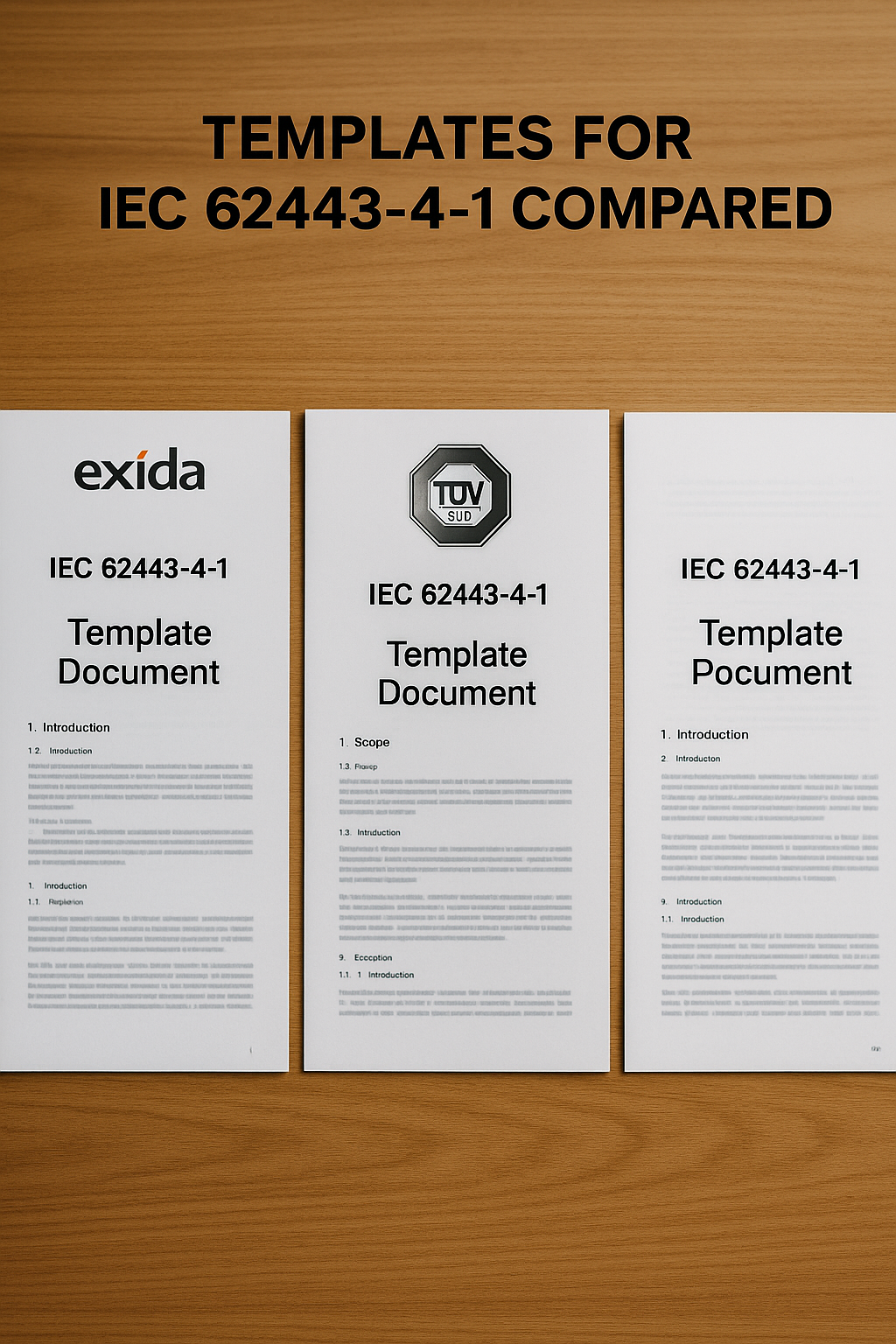
Templates for IEC 62443-4-1 compared — what Exida, TÜV SÜD and the free sample process cover, where gaps remain and what the CRA requires.
Contents
Exida solid process basis without vulnerability management
Exida offers template packages for operators and for OEMs. The OEM package is relevant for manufacturers.
It consists of editable Word documents and covers the core development processes: configuration management, requirements specification, security design, threat modeling, test planning and the review of the development process itself. In addition there is a coding standard and a user manual.
Two areas are missing. The package provides neither processes nor templates for vulnerability handling, and supplier management is only touched on. Both topics are the first to be noticed in audits and in CRA evidence collection. Anyone who buys the package must close these gaps with in-house work or external support.
For companies that already develop securely and only want to structure their processes, it is a usable starting point. Beginners miss worked examples that show what a finished artifact looks like.
Mittelstand-Digital Zentrum Hannover free overview no templates
The Mittelstand-Digital Zentrum Hannover provides a Musterprozess to support IT-secure product development. It traces the product development lifecycle according to IEC 62443-4-1, is freely available online and can be downloaded as a PDF.
For getting started this is the cheapest option on the market. The sample process names the relevant topic points and shows their order in the lifecycle. A development manager encountering IEC 62443-4-1 for the first time will understand within an hour what it is about.
It is not enough for implementation. The sample process stays at the conceptual level; there are no document templates and no worked examples. Translating it into company-specific processes and documents remains entirely the reader’s task.
TÜV SÜD Prüfer reputation with built-in consulting limit
TÜV SÜD offers a template package for implementing IEC 62443-4-1, which can be supplemented with workshops.
The name helps. A package from a recognized testing and certification organization is easier to push through internally, and the prescribed processes are aligned with the standard’s requirements.
The catch lies in the same role. As an independent certification body, TÜV SÜD may not provide extensive implementation consulting, because that could jeopardize its independence in a later audit. For the same reason the accompanying workshops are limited in scope. You buy templates from a party that can only help you fill them in to a limited extent.
As with Exida, there are no worked examples. The structure is there; you must develop the content yourself.
The three offers compared
Our template package
Our templates for the secure development process according to IEC 62443-4-1 are today part of the CRA template package, as the module “Development process and SDLC”. Included are process descriptions with roles, inputs, outputs and evidences, plus templates for security requirements, secure design, verification and test as well as for risk assessment and threat modeling. The module is available separately, without the complete package.
Two boundaries apply: the package does not replace an existing quality management system, and the standards themselves must be be purchased. A basic understanding of IEC 62443-4-1 is assumed by the templates.
Why IEC 62443-4-1 templates must be CRA-ready today
Manufacturers have two dates in their calendar. From 11 September 2026 the reporting obligations for actively exploited vulnerabilities and serious security incidents apply. From 11 December 2027 the Cyber Resilience Act applies in full, including evidence collection and conformity assessment.
The three offers described above are tailored to IEC 62443-4-1. None of their content descriptions lists a mapping of their artifacts to CRA requirements.
That does not make them worthless, but it pushes work down the line. A process manual that an auditor accepts against IEC 62443-4-1 does not yet answer the question a conformity assessment body will ask: which document demonstrates which CRA requirement. Building that mapping afterwards is more expensive than carrying it from the start. Anyone buying templates now should therefore check whether they will make the jump into CRA evidence collection. Which documents are required for that is listed on the page CRA templates for manufacturers.
How to recognize a useful template package
Four questions distinguish templates that save work from templates that create work:
- Are there worked examples? An empty form with headings costs almost as much time as a blank sheet. A fully worked example artifact shows the level of detail and language.
- Are roles, inputs, outputs and interfaces named? Most friction occurs between development, QA, product management and procurement, not within a single process step.
- Is there a mapping from requirement to evidence? Without it you only notice during the audit which document is missing.
- Are the documents editable and adaptable to your process landscape? You can read a PDF, but you cannot import it into your management system.
A package that fulfills all four points does not replace your own implementation. It shortens the path from standard requirement to reliable documentation, and that is precisely what templates are for.